Operating context
Signals, knowledge and decisions move through a controlled journey built around AIM Agent BuildLab. Each point represents a person, trusted information, a business rule or a connected system contributing current context.

Design, test and manage AI-led workflows across channels without losing control of business rules, approvals or handovers.
Discuss AIM Agent BuildLab

Signals, knowledge and decisions move through a controlled journey built around AIM Agent BuildLab. Each point represents a person, trusted information, a business rule or a connected system contributing current context.
AI assistance and human judgement stay connected as each interaction progresses. Intelligence supports understanding and action while explicit controls preserve confirmation, authority and escalation.
The platform layer brings channels, knowledge, workflow logic and human support into one operating model. That matters because a useful AI experience must do more than answer a question: it must understand the stage of the journey, work with approved information and know when a person should take over.
For AIM Agent BuildLab, the first step is to define the journey in operational terms. AIIT identifies the questions people ask, the information required, the systems involved and the moments where confidence or authority changes. This creates a bounded design that teams can review before automation is introduced.
The experience can then combine Visual conversation and workflow design, Reusable actions, variables and business rules, Testing, versioning and controlled release. Approved knowledge provides grounding, workflow rules preserve required steps, and integration points connect the conversation to current business context. If the request becomes uncertain, sensitive or exceptional, the interaction can pass to a person with the relevant history attached.
Implementation should progress in observable stages. A focused first journey gives stakeholders space to test language, decision boundaries, handovers and operational ownership. Feedback from real use can inform measured refinement without turning the system into an uncontrolled collection of disconnected responses.
The potential value is practical: Move from concept to working journey faster; Give operations teams clearer control; Keep experiences aligned across channels. The exact result depends on the organisation, its source information and the process being improved, so AIIT keeps discovery centred on the work itself rather than making assumptions about outcomes.
Operating ownership continues after launch. Source information needs responsible owners, journey changes need review and service teams need a clear way to report unexpected behaviour. These routines help the capability stay connected to current business practice rather than becoming a static layer around a changing process.
AIIT brings operational and technical perspectives into the same conversation. This helps teams evaluate not only whether a journey can be automated, but whether it can be supported, governed and improved with confidence over time.


Capture the journey, decisions and exceptions.
Assemble conversation steps, actions and rules.
Run realistic scenarios and edge cases.
Approve, publish and monitor with rollback ready.
Design a journey that qualifies new customers, captures the details sales needs and books the next step in the right calendar.
Let customers confirm, move or cancel appointments with rules for notice periods, availability and exceptions.
Connect to order, claim or job systems so customers can check progress without waiting for a person.
Launch temporary journeys for promotions, weather events or peak periods, then retire them cleanly.
Build assistants that answer staff questions about policies, systems and procedures.
Capture concerns carefully, classify urgency and route them to the right team with full context.
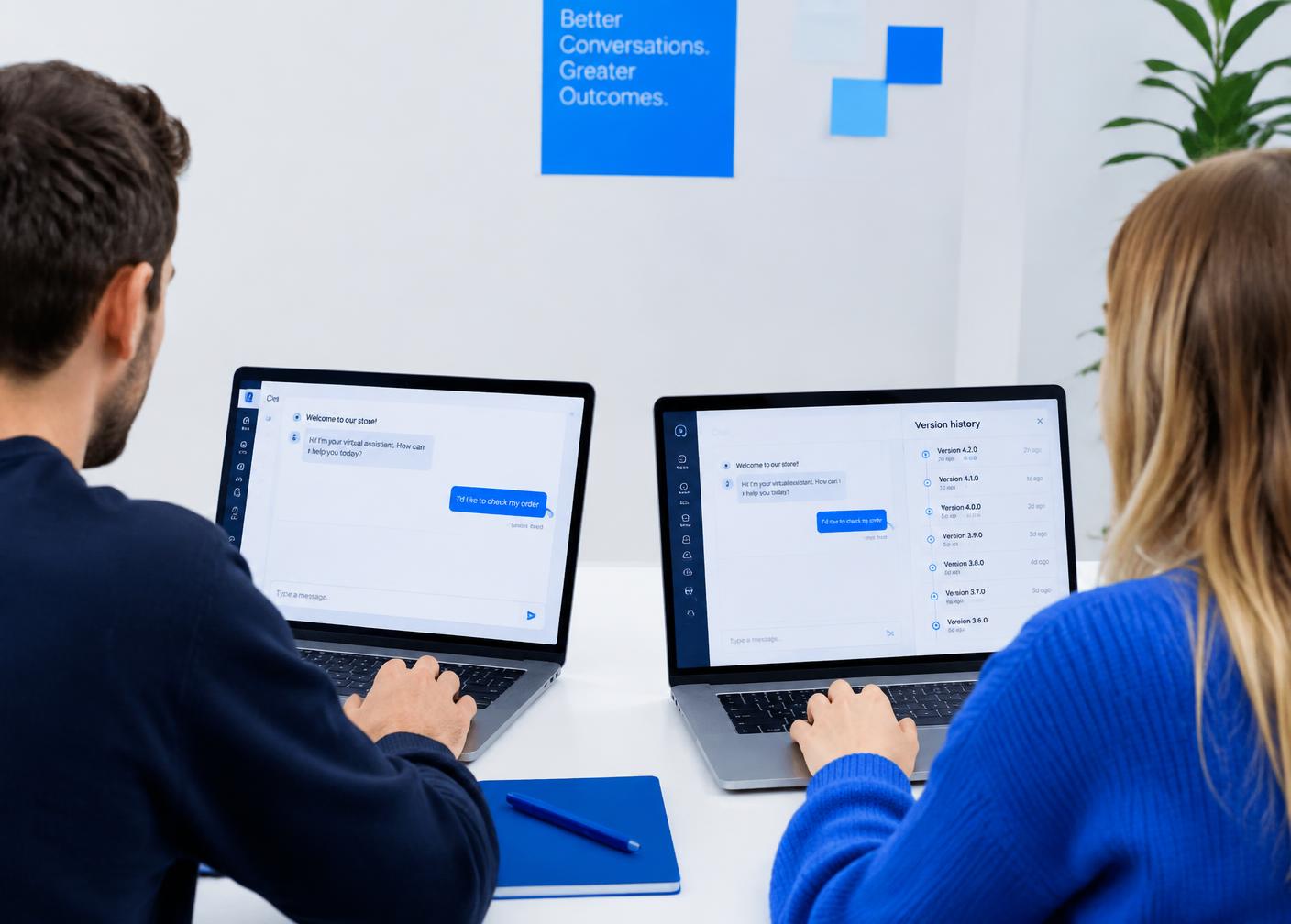
AIM Agent BuildLab gives your team a visual canvas for designing how a Digital AI Employee should handle a conversation from greeting to resolution. Each step shows what the AI is trying to learn, which system it may consult, what it should say and what happens when the answer is unexpected. Instead of a hidden prompt, you get a readable map that operations leaders, service managers and technical staff can discuss together.
Branches capture the realities of customer service: the caller who wants two things at once, the customer who cannot find a reference number, the enquiry that belongs to another team. Designers can attach clarifying questions, fallbacks and handovers to each branch, so the experience remains helpful when a conversation moves off the expected path.
Because the design is visual, it becomes a living operating document. New team members can understand how enquiries are handled, auditors can trace a decision, and improvements can be proposed by the people closest to customers rather than waiting in a development queue.
Common tasks such as verifying identity, looking up a booking, capturing an address or creating a callback request can be built as reusable actions. Once approved, they can be dropped into any journey, which keeps behaviour consistent and dramatically reduces the effort needed to launch a new use case.
Variables and business rules hold the details that change: opening hours, service areas, eligibility thresholds, escalation contacts and seasonal messages. When a rule changes, it is updated in one place and every journey that relies on it follows. The same design can serve voice, web chat, messaging, SMS and email, with channel-specific wording where it improves clarity.
This modular approach is what allows a SAM to take on more responsibility over time. Each new journey inherits tested components, so expansion becomes an exercise in configuration and review rather than a fresh build.
Studio includes a testing environment where teams can run realistic conversations, including difficult ones, before anything goes live. Scenario libraries capture typical requests, edge cases and previously observed problems, so each new version is checked against the situations that matter most to your business.
Releases are versioned and approved. If a change produces an unexpected result, the previous version can be restored quickly. Performance dashboards then show where conversations complete, where customers hesitate and where handovers occur, pointing directly to the next improvement.
The result is a disciplined cycle of design, test, release and learn. It gives operations teams genuine ownership of their AI Employees while keeping the safeguards that enterprise service requires.
Every AIIT deployment of AIM Agent BuildLab begins with a clear definition of what the AI may do, what it must never do and when it must hand over to a person. Those boundaries are written as configuration rather than left to chance, so they can be reviewed by operations, risk and compliance teams before anything reaches a customer. Access to systems is granted through scoped connections, and each connection is limited to the fields and actions the journey genuinely needs.
Conversation records, decisions and actions are logged so teams can see what happened and why. Sensitive information can be masked, retained for agreed periods or excluded from storage altogether, depending on your policies and the obligations that apply to your organisation. Client data is kept separate, and AIIT works with your team to align the deployment with New Zealand privacy expectations and your own security standards rather than asking you to accept a generic template.
Governance is also practical. Changes move through testing and approval before release, previous versions can be restored, and performance is reviewed against agreed measures. The aim is simple: a capability your people trust enough to use every day, because they understand how it behaves and can correct it when the business changes.
Large enterprises use AIM Agent BuildLab to bring consistency to high-volume service, where thousands of similar requests arrive every week across several channels and teams. In that setting, the value comes from dependable handling of routine work, clean handover of complex cases and reliable records that support reporting, compliance and continuous improvement. Integration with existing contact-centre, CRM and core platforms means the capability strengthens current investments rather than replacing them.
Medium-sized companies often face a different challenge: growing demand without a matching increase in headcount. Here AIM Agent BuildLab helps a small service team cover more hours, respond faster and keep information organised, while the people on the team focus on the conversations that need experience, empathy and judgement. Deployments can start with one department and extend as the benefits become clear.
Small New Zealand businesses benefit from the same foundations in a simpler form. Owners and small teams use AIIT capabilities to answer enquiries when they are busy on the job, capture complete details for quotes and bookings, and present a professional first impression every time. Whatever the size of the organisation, the principle is identical: a Digital AI Employee handles the repeatable work within clear rules, and people remain in charge of the relationships and decisions that matter most.
AIIT does not ask you to rely on generic industry figures. Before a pilot begins, we agree the measures that reflect your goals, which might include response times, completion rates, handover quality, after-hours coverage, customer effort, administrative time saved or the share of enquiries resolved without follow-up. A baseline is captured from your current operation so the comparison is fair.
During and after the pilot, dashboards and regular reviews show how AIM Agent BuildLab is performing against those measures. Where results fall short, the conversation data usually shows why, whether that is unclear knowledge, a missing integration or a rule that needs refining, and the next improvement can be planned with confidence. This evidence-led approach helps leaders make sound investment decisions and gives teams a clear view of how the capability is helping them.
An AI capability is only as helpful as the information and actions available to it. AIM Agent BuildLab connects to the systems that already run your organisation, such as CRM platforms, booking and scheduling tools, contact-centre software, ecommerce and order systems, policy or account platforms, knowledge bases and document stores. Those connections allow the AI to answer with current information and to complete tasks rather than simply telling customers to call back later.
AIIT designs each integration around the minimum access required. Read and write permissions are separated, sensitive fields can be excluded, and every action taken through a connection is logged. Where a system does not offer a modern interface, AIIT can work with secure file exchange, email workflows or intermediate services so the journey still flows smoothly. When systems are unavailable, the AI explains the situation honestly and captures what is needed for follow-up.
Connected data also improves the experience for your people. Summaries, outcomes and structured fields are written back to the records your team already uses, so nothing needs to be copied between screens. Reporting draws on the same information, giving leaders an accurate view of demand, resolution and handover across every channel.
Introducing a Digital AI Employee changes how work is shared, and AIIT treats that change with care. We involve frontline staff early, because they know where customers struggle and which tasks drain their time. Their input shapes the journeys, the handover rules and the wording customers hear, which leads to better results and stronger support for the new way of working.
As routine work moves to AIM Agent BuildLab, team members can spend more time on complex cases, relationship building and service improvement. Training, clear escalation paths and regular reviews help everyone understand what the AI handles and how to work alongside it. The outcome AIIT aims for is not fewer good people, but good people doing more meaningful work with better tools.
AIIT starts with your operation, not a product demonstration. We map the journeys that create the most repetitive effort or the most customer frustration, identify the systems and knowledge involved, and agree what a successful outcome would look like. That shared baseline matters, because it lets everyone judge the pilot on evidence from your organisation rather than on assumptions.
A focused pilot then puts AIM Agent BuildLab to work on a small number of well-defined journeys. Your team reviews real interactions, refines wording and rules, and decides when coverage should expand. As confidence grows, the same foundations extend to new channels, departments and use cases without rebuilding from scratch. AIIT remains involved throughout, providing configuration, monitoring and ongoing improvement from Auckland, so you have a local partner who understands how New Zealand customers speak and what they expect.
Browse 81 Typical SAM Roles — from receptionist and claims specialist to compliance, sales and operations — each a Digital Employee powered by ANNA and managed by AIM.
Tell us what you want to improve. Your enquiry will go directly to the AIIT team in Auckland.