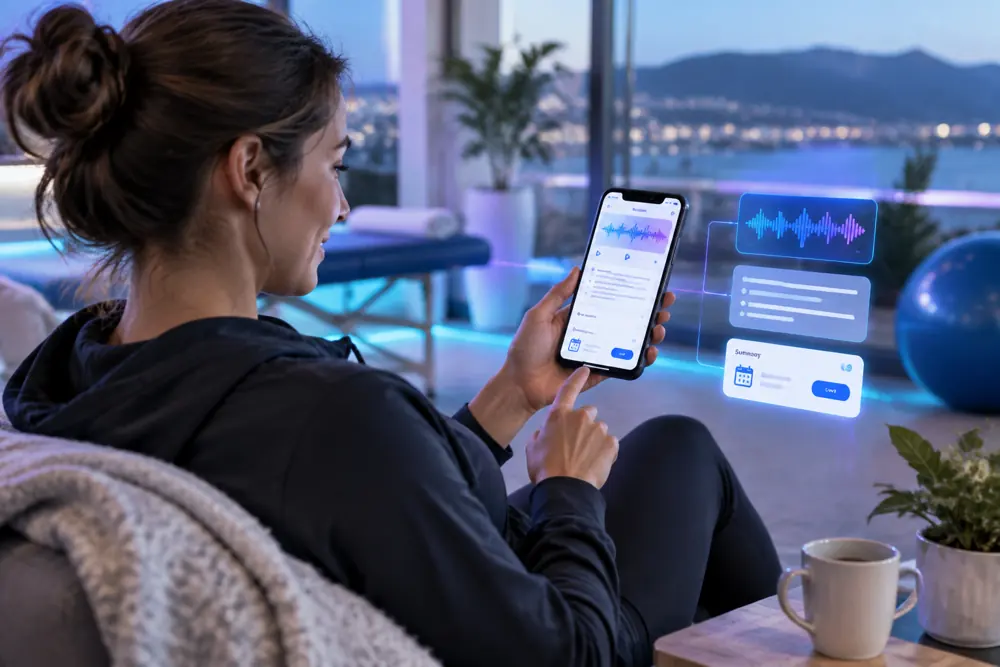
Appointments, intake, rescheduling, reminders. Give customers a natural, responsive way to reach your business while your people stay focused on the work only they can do.
Never let the right enquiry become another missed call.
For physio clinics, the phone rarely rings at a convenient moment. A customer may call while the team is with another client, handling equipment, travelling between jobs or working through a time-sensitive task. AIIT Voice AI creates a dependable front door for those moments. It can answer on a real business number, understand the reason for contact, ask relevant questions and move the conversation towards a useful next step.
The experience is designed around natural speech rather than a long keypad menu. Callers can speak in their own words, interrupt, clarify and change direction. Low-latency architecture supports a responsive rhythm, while clear prompts and business-specific logic keep the conversation purposeful. The goal is not to pretend that technology is a person. It is to make routine contact feel easy, capable and respectful, with a clear path to a human whenever judgement, empathy or expertise is required.
For your business, the primary workflow is straightforward: appointments, intake, rescheduling, reminders. AIIT then connects that flow with the wider customer journey, including messages, confirmations, follow-up questions, recordings, summaries and structured details for the team. Each implementation is configured around your services, hours, coverage, escalation rules and existing systems rather than imposed as a generic script.
Physio clinics team at work while AIIT Voice AI answers customer calls
Physio clinics workflow coordinated across channels
Customer details prepared for a confident handover
Physio clinics booking and follow-up in progress
Business owner reviewing Voice AI conversation outcomes
SUPER AGENT MODEL · SAM
Your one-of-a-kind SAM Smart Receptionist for physio clinics.
Your SAM Receptionist is completely unique — custom-designed with a personalised voice, personality and capabilities for your physio clinics business. Kiwi accent is standard, and the choice is yours. "She'll be alright mate" — yes, your SAM speaks Kiwi if you want it to.
Your SAM answers every physio clinics call with a warm, professional Kiwi voice.Recordings, transcripts and pre-booked jobs wait in the app until you're ready.
Perfectly Human AI
The ANNA powered Super Agent Model, or SAM, makes the perfect Smart Receptionist for physio clinics. A virtual "Digital Person" with a unique name, personality, skills, knowledge and natural human speaking voice — all customised to your specifications.
Human Level IQ of 130
Our Advanced Neural Network Architecture (ANNA) understands complex physio clinics requests and scenarios, delivering intelligent answers that show your business in the best light and build strong relationships with callers.
Emotional Intelligence (EQ)
Recognises the caller's subtle emotions and adapts tone and delivery, giving empathetic responses that make customers feel valued — building trust, loyalty and repeat business. Your SAM is pre-trained with industry and service experience.
Handles up to 20 Calls Simultaneously
Huge call capacity means no wait times in peak periods. Advertising campaign or busy season, every lead is captured with a friendly conversation.
24/7 Availability
Capture after-hours enquiries and urgent calls when competitors are unavailable. Jobs wait in the mobile app for you to confirm, reschedule or decline when you start your day.
Call Recording & Transcriptions
Full call recordings, text transcription and smart action summaries let you prepare before returning calls — all available on the go in the mobile app.
Job Pre-Booking & Semi-Auto Scheduling
Fills your physio clinics calendar by booking or pre-booking work, reducing back-and-forth and keeping your schedule busy and organised. You decide when to speak with clients.
Memory — Know Your Customers
Repeat-caller recognition and conversational memory: if a call drops or a customer rings back later, your SAM remembers who they are and what was discussed.
Eliminate Spam & Time Wasters
Your SAM acts as a digital gatekeeper, screening every call so your valuable time is spent only on the matters that count.
From the ground up, your Super Agent Model is custom-tailored to your business. We develop a distinct personality, a memorable name and a backstory that make your SAM stand out, then add specialised sales training so it handles incoming communications with professionalism and efficiency.
The true magic lies in your SAM's voice — a distinctive, human-like synthetic voice fine-tuned on real human speech and tailored to your preferred accent. We develop, train, test, deploy and configure your unique Smart Receptionist to represent your physio clinics business and capture exactly the information you need from callers.
One intelligence system. A complete Digital Employee workforce.
ANNA OS provides the conversational intelligence. Each Super Agent Model becomes a specialist Digital Employee. The AIIT Agentic Intelligence Management system gives your physio clinics business the controls to direct, measure, govern and expand the whole team.
Customers can move between voice, web chat, SMS, email, WhatsApp, Messenger, Instagram and other approved channels while AIM preserves the relevant journey context and operating rules.
Hear ANNA answer a call for Mauri Ora Physio & Performance.
A two-minute sample call for an example physio clinics business, recorded with natural New Zealand voices. Press play to listen, or step through the transcript.
Press play to start the sample call.
Mauri Ora Physio & Performance is a fictional example business. Voices are AI-generated samples; a live AIIT deployment is tailored to your business and runs on your real phone number.
SAVINGS CALCULATOR
Estimate time and cost savings for your physio clinics business.
Adjust the sliders to match your call volume, team and hours. Results are indicative estimates only, not a quote or guarantee.
Staff time freed per month17 hoursLabour cost freed per month$532Missed calls answered per month62Potential revenue from those calls*$4,676
Your phones are unattended about 73% of the week, and each team member currently spends roughly 8.0 hours a week on calls. *Assumes 30% of recovered calls convert; adjust for your own experience.
Get a Voice AI quote for your physio clinics business.
Tell us about your calls, operating hours and goals. The AIIT team in Auckland will reply with a tailored next step.
FIVE PRACTICAL WORKFLOWS
Built around how physio clinics operate.
Appointments, intake, rescheduling, reminders through a natural, structured conversation that collects the details your team needs before the handover.
Answer routine questions about services, coverage, availability and next steps using information approved by your physio clinics team.
Recognise urgent, sensitive or unusual requests and route them to a person with a concise summary and the conversation context.
Follow up incomplete enquiries by the customer's preferred channel while retaining consent, history and the original reason for contact.
Create consistent records for bookings, quotes, call-backs and service requests so fewer details are lost between reception and delivery.
NATURAL VOICE
A conversation, not a telephone maze.
Customers contact physio clinics because they want an answer, a booking or confidence that somebody has understood the situation. Voice AI can invite the caller to explain what they need in ordinary language, identify the relevant intent and guide the conversation without making them memorise menu options. Carefully designed prompts keep questions short and contextual. Interruption handling lets callers add information naturally, and confirmation steps reduce the risk of names, addresses, dates or contact details being captured incorrectly.
Speech quality matters, but the complete experience matters more. AIIT considers voice selection, pronunciation, pacing, turn-taking, background noise, call routing and the way the agent handles uncertainty. Industry vocabulary, local place names and the language your customers actually use can be incorporated during configuration and testing. Where multilingual support is appropriate, journeys can be designed so the service recognises language preference and preserves the same core business rules across supported languages.
The Voice AI can operate on a real phone number and follow your published availability and escalation policy. Outside normal hours it can collect a complete request, communicate realistic next steps and identify cases that meet your rules for urgent escalation. During busy periods it can absorb routine demand without changing the customer's entry point. Calls can be recorded where lawful and appropriate, and summaries can make the next human action easier to understand.
ONE AGENT · EVERY CHANNEL
Carry the context beyond the call.
A customer journey often starts on one channel and finishes on another. Someone may discover the business on Instagram, ask a question in Messenger, call to clarify, receive an SMS confirmation and later reply by email. A disconnected approach forces the customer to repeat themselves and leaves the team searching across separate inboxes. AIIT designs a unified conversation layer so Voice AI, WhatsApp, Instagram, Messenger, web chat, SMS and email can follow consistent logic and share the context that the business chooses to retain.
For physio clinics, this can mean moving from an initial enquiry to a structured next step without losing the reason for contact. The agent can send a confirmation, request an appropriate photo or document, provide a secure link, capture a preferred appointment window or remind the customer about information they need to prepare. Channel choice becomes part of the experience: urgent or complex matters can move to voice, while simple confirmations and updates can remain in messaging.
Omnichannel does not mean every channel must be activated at once. A practical rollout may begin with voice and SMS, then add web chat or messaging after the core workflow is stable. The same approved knowledge, routing rules, consent handling and handover expectations can support each phase. This gives the business a controlled way to expand access while protecting the consistency of its service.
CONVERSATIONAL LOGIC
Business rules that know when to stop.
Advanced conversational logic combines flexible understanding with deterministic controls. The agent can recognise broad customer language while still following precise rules for service areas, opening hours, eligibility, urgency, availability and escalation. For the core physio clinics workflow—appointments, intake, rescheduling, reminders—that means asking only the questions needed to determine the next appropriate action. Answers can change the path in real time rather than forcing every caller through the same script.
Good automation also recognises its limits. Low-confidence understanding can trigger a clarification. Sensitive, unusual or high-impact matters can move to a person. The handover can include the caller's intent, captured details, relevant answers and a concise summary, reducing the need to restart the conversation. Your team remains responsible for professional advice, safety decisions and exceptions that require human judgement.
Integration can connect the conversation with calendars, CRM records, service-management tools, ticketing, quoting or other systems already used by the business. Actions are constrained by permissions and validation. Where direct integration is not yet appropriate, the agent can prepare a structured email, task or callback request. This staged approach lets the business prove the workflow before increasing automation depth.
CONTROL & GOVERNANCE
Designed for secure, accountable operation.
Every Voice AI deployment should start with a clear view of the information being collected, why it is needed, where it goes and who can access it. AIIT designs journeys around data minimisation, role-aware access and clear retention decisions. Customer data can be isolated by client environment, and integrations can be limited to the specific actions required for the approved workflow. Security, privacy and regulatory obligations remain specific to the organisation, the information involved and the configuration selected.
Operational governance includes more than technical safeguards. Teams need ownership of the approved knowledge, escalation rules, service messages and exceptions. Conversation review can reveal unclear questions, emerging enquiry themes and points where customers abandon or request human help. Versioned changes and controlled testing help the business improve without introducing unexpected behaviour into a live journey.
Success should be evaluated against agreed measures rather than marketing promises. Useful indicators may include answered-enquiry coverage, completed qualification, booking conversion, handover quality, response time, customer feedback and the amount of repetitive administration removed from the team. A pilot focused on one high-value journey creates evidence that can guide the next investment decision.
IMPLEMENTATION
From first workflow to a service that keeps improving.
AIIT begins by listening to real enquiry patterns and the people who handle them. Together we map the reasons customers make contact, the information required, common variations, safety or policy boundaries, and the moments where a person should take over. We then shape the conversational flow, approved answers, system actions and follow-up messages around the way the business already succeeds.
Testing should include normal requests, interruptions, incomplete answers, strong accents, background noise, ambiguous language and deliberately difficult edge cases. For physio clinics, scenarios should reflect the practical reality of appointments, intake, rescheduling, reminders rather than a polished demonstration. Staff feedback is essential because the quality of downstream information determines whether the service genuinely helps operations.
After launch, the service can be monitored and refined in measured increments. New questions can be added to approved knowledge, routing thresholds adjusted, and additional channels introduced when there is evidence they will improve access. The result is not a static bot. It is an accountable customer-contact capability that can evolve with demand, services and the expectations of the people your business serves.
CONNECTED CUSTOMER JOURNEY
One agent across every channel your customers use.
Start where the customer chooses and continue the conversation without losing the purpose, details or agreed next step.
01
Voice calls
Calls to your physio clinics business can be answered with natural speech, relevant qualification and a defined path to booking, callback or urgent human help.
02
WhatsApp & Messenger
Messaging conversations can answer common questions, collect structured details and continue a journey that began by phone without asking the customer to start again.
03
Web chat
A website visitor can move from browsing to a useful conversation, receive an approved answer and request the right next action without waiting for office hours.
04
SMS & email
Confirmations, reminders and practical follow-ups can be sent in concise form, while replies remain connected to the original enquiry and customer record.
05
Instagram enquiries
Social enquiries can be recognised as genuine service opportunities, qualified consistently and moved into the most suitable private channel for the next step.
For physio clinics, channel design should follow customer intent rather than technology trends. A person with a complex or urgent need may prefer to speak. Someone confirming an appointment may want a quick message. A prospect researching options might begin in web chat or Instagram and then choose a call when the decision becomes more detailed. AIIT maps these transitions deliberately so each channel has a clear role and customers are not trapped in an automated loop.
The agent can use a common source of approved business information while adapting the interaction to each format. Voice prompts stay brief and conversational. Messaging can present short choices, links and written confirmations. Email can support longer information and attachments. Across all of them, identity, consent, access and retention decisions can be applied according to the organisation's requirements. The objective is a coherent service experience, not simply a larger collection of automated inboxes.
Human availability remains visible throughout the design. A customer can be transferred, offered a callback or routed to the right team when the journey reaches a boundary. The receiving person can see why the customer contacted the business, what has already been captured and what action was promised. That continuity protects trust and lets automation support the team rather than becoming another system the team has to work around.
A CONTROLLED PATH TO VALUE
Five stages from discovery to dependable operation.
01
Discover the demand
The first stage examines when and why customers contact the business. For physio clinics, that includes the language callers use, the questions staff repeatedly answer, the details required before work can begin, and the reasons an enquiry needs immediate human attention. Existing call notes, inbox themes and team interviews can reveal a practical starting point. The result is a prioritised journey with clear boundaries, not a broad promise to automate everything.
02
Design the conversation
The next stage turns that journey into natural dialogue. We define the opening, useful clarifications, confirmation wording, recovery when an answer is unclear, and the route to a person. Tone should match the business: capable and concise for an urgent request, warmer for a care-related interaction, or consultative for a considered purchase. The design also identifies which information can be stated confidently and which questions must be answered by a qualified team member.
03
Connect the workflow
A useful agent must leave the operation in a better state. This stage maps approved actions into calendars, customer records, service tools, email queues or callback lists. Data fields are validated before submission, duplicate records are considered, and failure paths are made visible. If a system is unavailable, the conversation should set an honest expectation and preserve the request for follow-up rather than silently losing it. Integration depth can increase only after the core journey performs reliably.
04
Test real-world variation
Testing covers far more than the ideal script. It includes hesitant callers, corrections, interruptions, noisy environments, uncommon names, local terminology, unexpected combinations and requests that sit outside the intended scope. Staff assess whether summaries are actionable and whether escalation happens early enough. Privacy notices, recording choices and consent language are reviewed in context. A limited release can then expose the service to genuine demand while maintaining close oversight and a simple rollback path.
05
Measure and improve
Once live, the business reviews evidence against the agreed objective. For physio clinics, that may include how many suitable enquiries reached a next step, how complete the captured information was, where customers asked for a person and how often teams needed to correct a record. Review is used to refine prompts, knowledge and routing—not to remove human judgement. Additional journeys and channels are introduced when the first service demonstrates quality, operational fit and customer value.
DAY-TO-DAY OPERATING GUIDE
What a well-run Voice AI service looks like.
The strongest results come from treating the agent as an operational service with owners, boundaries and regular review—not as a set-and-forget recording.
Before the conversation
Keep the agent's approved information aligned with the way the business currently operates. For physio clinics, this may include service descriptions, areas covered, opening hours, appointment constraints, expected response windows and the circumstances that require a person. Changes should have an owner and an effective date. If the business is fully booked, operating reduced hours or introducing a new service, the customer-facing conversation should change at the same time as the website, roster and team instructions.
Decide what information is genuinely needed at first contact. Asking for everything creates friction and can collect data before it has a clear purpose. A useful opening journey normally captures the reason for contact, a reliable reply method, enough context to choose the next action and any details needed to apply an approved priority rule. Additional information can be requested later by the team or through a secure follow-up step when it becomes relevant.
During the conversation
Good Voice AI makes its questions easy to answer. It avoids long explanations, separates complex requests into manageable turns and confirms details that are costly to misunderstand. When a caller gives several pieces of information at once, the agent should retain what it can and ask only for what remains. When uncertainty persists, it should acknowledge that clearly and offer a sensible recovery instead of repeatedly guessing.
For the main workflow—appointments, intake, rescheduling, reminders—the conversation should state what will happen next and avoid commitments the underlying business cannot reliably meet. If an appointment is provisional, say so. If the request requires review, describe the review. If safety, professional judgement or an unusual exception is involved, move to a trained person. A concise, honest interaction often produces more confidence than an automated answer that tries to sound certain about everything.
After the conversation
The end of the call is the beginning of operational follow-through. The customer can receive a confirmation in the appropriate channel, while the team receives a structured summary with the captured details and expected next action. Ownership should be explicit: a callback request needs a queue, a due time and a person or role responsible for it. If an automated action fails, the service should create visibility for recovery and avoid telling the customer that a booking or submission succeeded when it did not.
Conversation outcomes can also improve the wider business. Repeated questions may signal that website information is unclear. Frequent requests outside the service area may suggest a referral opportunity. Abandoned journeys can expose unnecessary questions, and human transfers can identify topics the agent should handle differently. Review should focus on patterns and service improvement while respecting the organisation's privacy, access and retention decisions.
When demand changes
Small-business demand can shift quickly with weather, seasonal work, events, staff availability or campaigns. The conversation layer should have a controlled way to reflect those changes. Temporary messages, qualification rules and routing can be prepared in advance for predictable peaks. Capacity limits should be represented honestly so the agent helps prioritise or schedule enquiries rather than creating an unrealistic promise that the team must repair later.
Concurrency can help absorb bursts of routine demand, but handling more conversations is valuable only when downstream work remains manageable. AIIT therefore considers the complete flow from contact to fulfilment. Rate limits, appointment inventory, callback capacity and escalation staffing all influence the appropriate configuration. The service can protect focus by gathering information and setting expectations even when immediate fulfilment is not available.
How people stay in control
The team should know what the agent handles, how to see its work and how to intervene. Simple operating procedures can cover pausing a journey, correcting approved knowledge, reviewing an escalation and reporting a concerning interaction. Staff training should explain both capabilities and limitations so people neither distrust useful automation nor assume it can make decisions outside its designed scope.
Customers also need meaningful control. They should be able to ask for a person, correct a misunderstood detail and understand the next step. The design can disclose that the interaction uses AI in language appropriate to the channel and organisation. Clear choices are especially important when the subject is sensitive, the customer is vulnerable, or a decision may materially affect them. Accessibility requirements should be considered across speech, messaging and follow-up formats.
How progress is assessed
A baseline makes improvement visible. Before deployment, the business can record current answered-call coverage, enquiry completeness, response delays, common administrative effort and relevant conversion or service measures. After launch, the same measures can be reviewed alongside customer feedback, transfer reasons and exception rates. The aim is not to maximise automation. It is to improve access and operational quality without weakening trust.
For physio clinics, a review might ask whether the workflow captured the details staff actually needed, whether customers reached an appropriate next step and whether the team spent less time reconstructing incomplete messages. Results should be segmented by journey and channel because a strong booking flow can conceal a weak escalation path. Evidence then guides targeted changes: clearer wording, a different question order, updated knowledge, tighter routing or a decision to keep a particular interaction fully human.
BUSINESS VALUE
01
More opportunities captured when the team is serving customers, travelling, on site or away from the phone.
02
A polished first response that reflects how physio clinics actually work, without forcing callers through rigid menus.
03
Cleaner qualification and scheduling information, helping people prepare before they call back, quote, attend or dispatch.
04
One connected conversation across phone, messaging and digital channels instead of isolated inboxes and repeated questions.
05
A measurable service layer that can be reviewed and improved using enquiry themes, handover quality and completion outcomes.
START WITH ONE HIGH-VALUE JOURNEY
Build a Voice AI experience for physio clinics.
We will map the calls, questions, handovers and systems that matter most, then define a measured path from first conversation to a production-ready service.
Browse 81 Typical SAM Roles — from receptionist and claims specialist to compliance, sales and operations — each a Digital Employee powered by ANNA and managed by AIM.